
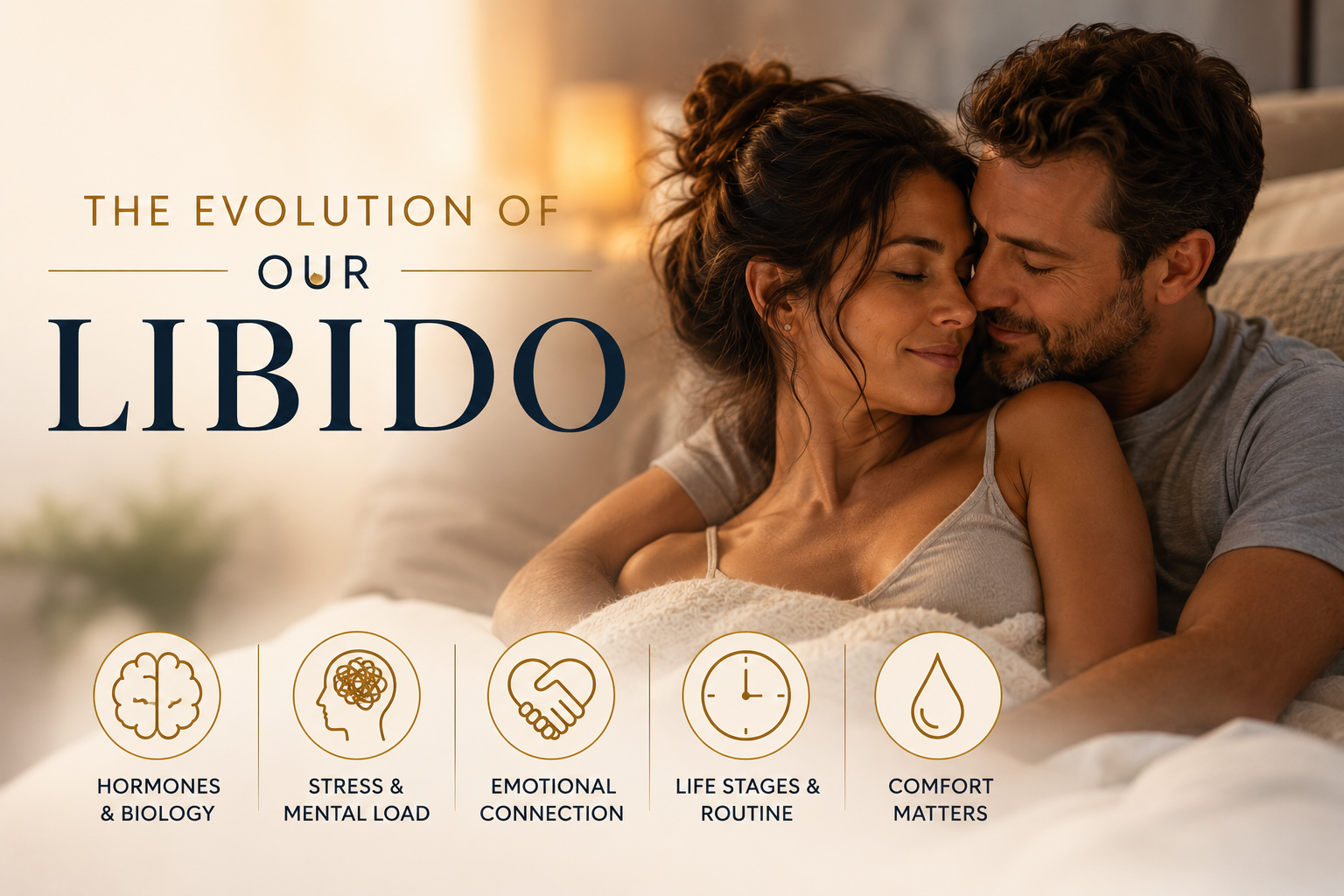
When Libido Changes in Long-Term Relationships (And Why It’s Completely Normal)
Let’s get one thing straight before we start.
If your sex drive isn’t exactly what it was during the early, butterflies-and-late-night-texting phase of your relationship… nothing is wrong with you.
Libido changes.
Relationships evolve. YOU EVOLVE.
Bodies shift. Life shifts.
And despite what movies, Instagram and questionable relationship advice might suggest, long-term desire rarely looks like the honeymoon phase forever.
The good news? Understanding how libido works and why it changes can actually make intimacy better, deeper, and far more connected over time.
Let’s talk about it.
First: What Is Libido, Really?
Libido simply refers to sexual desire or interest in sexual activity. But it isn’t a fixed setting in your brain.
It’s influenced by a surprisingly wide range of factors, including:
• Hormones
• Stress levels
• Emotional connection
• Sleep and overall health
• Medications
• Life stages (pregnancy, menopause, aging, injury)
• Relationship dynamics
Research consistently shows that sexual desire fluctuates across a lifetime and especially within long-term relationships.
A study published in the Journal of Sex Research found that sexual desire naturally declines over time for many couples, particularly when stress, routine, and competing life demands increase. But that decline doesn’t necessarily mean less satisfaction or connection. In many cases, couples simply experience desire differently as their relationship matures.
(Source: Journal of Sex Research, McNulty et al., 2019)
In other words: desire doesn’t disappear, it evolves.
The Honeymoon Phase vs Real-Life Desire
Early relationships are powered by a cocktail of brain chemicals.
Dopamine.
Norepinephrine.
Oxytocin.
These neurochemicals create that familiar “can’t stop thinking about you” feeling.
According to anthropologist Helen Fisher, the intense phase of romantic attraction typically lasts 12–18 months before stabilizing into deeper attachment and companionship.
(Source: Fisher, H. Why We Love: The Nature and Chemistry of Romantic Love)
Once the nervous system settles, desire may feel less spontaneous but that doesn’t mean it’s gone.
It simply means your relationship is moving into a new phase where connection, communication, and intentional intimacy matter more than chemical fireworks.
The Biggest Libido Myth
Here’s a myth that causes unnecessary anxiety in long-term couples:
“If you’re attracted to your partner, you should want sex all the time.”
That’s simply not how human sexuality works.
Sex therapist Dr. Emily Nagoski explains that many people experience responsive desire, not spontaneous desire.
Spontaneous desire = feeling horny out of nowhere.
Responsive desire = desire that develops after arousal begins.
In other words, many people don’t feel desire until intimacy, touch or emotional connection starts.
(Source: Nagoski, E. Come As You Are, 2015)
Understanding this difference can be a game-changer.
It means that sometimes, desire follows connection rather than leading it.
Why Libido Can Change in Long-Term Relationships
Several factors commonly influence desire over time:
Stress and Mental Load
When your brain is busy juggling deadlines, childcare, or life logistics, it’s harder for your nervous system to shift into a relaxed, receptive state for intimacy.
Research from the Archives of Sexual Behavior shows stress is one of the most significant predictors of reduced sexual desire.
(Source: Archives of Sexual Behavior, Hamilton & Meston, 2013)
Hormonal Changes
Hormonal shifts across the menstrual cycle, postpartum periods, perimenopause, and menopause can all influence libido and natural lubrication levels.
Lower estrogen levels can also increase vaginal dryness or sensitivity, which may make intimacy less comfortable if friction isn’t reduced.
(Source: North American Menopause Society)
Familiarity and Routine
Humans are wired to seek novelty. Long-term relationships naturally move toward familiarity and comfort which is wonderful for emotional safety, but sometimes requires more intentional effort to keep desire alive.
Small Shifts That Can Make a Big Difference
The good news is that libido in long-term relationships often responds well to small changes.
Here are a few expert-supported strategies that couples find helpful.
1. Focus on Touch, Not Just Sex
Physical touch activates oxytocin, the bonding hormone that helps people feel connected and safe.
That can include:
• cuddling
• massage
• slow kissing
• playful physical contact throughout the day
These moments can help your nervous system shift toward intimacy naturally.
2. Build Anticipation
Anticipation activates dopamine, the brain’s motivation and reward chemical.
Try things like:
• sending playful messages during the day
• planning intentional “no phone” evenings
• exploring different types of touch or intimacy
Sometimes the build-up is just as powerful as the act itself.
3. Reduce Pressure Around Arousal
When people feel pressure to perform or “be in the mood,” the nervous system often does the opposite.
Instead of focusing on whether desire is there yet, focus on creating conditions where it can develop naturally.
Think of intimacy as exploration, not a performance.
4. Make Comfort Part of the Equation
Physical comfort matters more than many people realize.
As hormone levels shift particularly in long-term relationships and different life stages, natural lubrication can fluctuate.
Adding lubrication simply reduces friction and enhances sensation, making touch feel smoother and more comfortable for everyone involved.
Many couples find that incorporating a body-safe lubricant makes intimacy feel more relaxed and responsive.
Because sometimes, a small practical adjustment can make a surprisingly big difference.
The Real Secret to Long-Term Desire
Healthy sexual relationships aren’t defined by constant passion.
They’re defined by curiosity, communication, and adaptability.
Bodies change.
Life changes.
Desire changes.
And when couples approach those changes with openness rather than pressure, intimacy often becomes more connected and fulfilling over time.
Final Thoughts
If your libido has shifted in a long-term relationship, you’re not alone and you’re certainly not broken.
Understanding how desire works can remove a huge amount of unnecessary pressure.
Because great intimacy isn’t about chasing the honeymoon phase forever.
It’s about learning how to grow with each other and sometimes that starts with simply having the conversation.
💛 Liquid Gold
Credible Sources Used
• Nagoski, Emily. Come As You Are: The Surprising New Science That Will Transform Your Sex Life (2015)
• Fisher, Helen. Why We Love: The Nature and Chemistry of Romantic Love
• McNulty, J.K. et al., Journal of Sex Research (2019)
• Hamilton, L., & Meston, C. Archives of Sexual Behavior (2013)
• North American Menopause Society (menopause.org)