
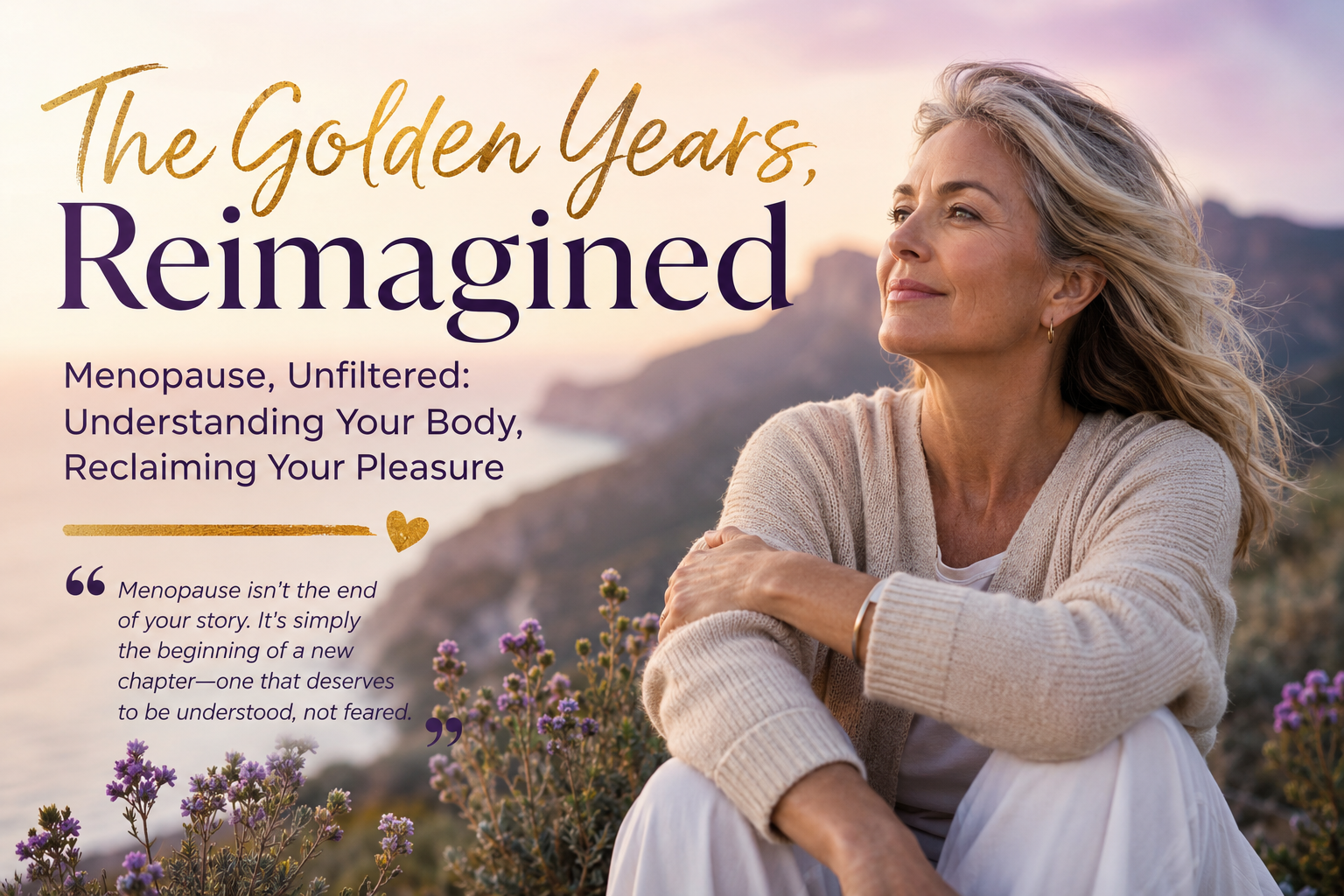
The Golden Years, Reimagined
Menopause, Unfiltered: Understanding Your Body, Reclaiming Your Pleasure
“Menopause isn’t the end of your story. It’s simply the beginning of a new chapter one that deserves to be understood, not feared.”
Too Busy to Read?
Here’s the short version:
Menopause is a natural life transition, not a disease. While hormonal changes can affect everything from sleep and mood to libido and vaginal comfort, they don’t mean intimacy or pleasure are off the table.
The more you understand what’s happening in your body, the better equipped you are to make informed choices that support your health, relationships and confidence.
Whether you’re experiencing menopause yourself, supporting a partner, or simply wanting to learn more, this chapter deserves openness not silence.
Let’s Bust a Myth Straight Away…
Somewhere along the way, menopause got a bad reputation.
It’s often portrayed as a season filled with hot flushes, mood swings and the end of your sex life.
But here’s the truth:
Menopause isn’t something your body does to you.
It’s something your body naturally moves through.
Just like puberty, it’s a normal biological transition. The difference is that while puberty is celebrated with books, conversations and milestones, menopause has too often been met with whispers, stigma and misinformation.
It’s time to change that.
So… What Exactly Is Menopause?
Despite how often we talk about it, menopause itself is actually just one moment in time.
It is officially diagnosed after 12 consecutive months without a menstrual period, marking the end of your reproductive years.
The years leading up to this are called perimenopause, and this is when most people begin noticing changes.
Perimenopause can last anywhere from a few years to over a decade. During this time, your ovaries gradually produce less oestrogen and progesterone. These hormones don’t decline in a neat, predictable line; they fluctuate, which is why symptoms can feel like they appear out of nowhere.
One week you might feel completely yourself.
The next you’re wondering why you’re suddenly awake at 3 a.m., sweating through your pyjamas and forgetting why you walked into the kitchen.
(We’ve all been there… well, maybe not all of us but many of us!)
And while hot flushes tend to steal the spotlight, they’re only one piece of a much bigger picture.
What’s Actually Happening Inside Your Body?
Oestrogen is an incredibly hardworking hormone.
It helps maintain:
- Healthy vaginal tissue
- Natural lubrication
- Bladder function
- Bone strength
- Skin elasticity
- Brain function
- Blood flow to the genitals
As oestrogen levels decline, these tissues naturally change too.
The vagina may become drier, the tissue thinner and less elastic, and intimacy may feel different than it once did.
Healthcare professionals refer to these changes as Genitourinary Syndrome of Menopause (GSM) a common and treatable condition that affects many people after menopause.
You might notice:
- Vaginal dryness
- Increased sensitivity or irritation
- Pain during intercourse
- More frequent urinary tract infections
- Bladder urgency or leakage
If this sounds familiar, know this:
These are common changes but they are not something you simply have to “put up with.”
Support is available.
It’s About More Than Hormones
Menopause isn’t only physical.
It can influence how you feel emotionally, mentally and relationally too.
Many people experience changes in:
- Sleep quality
- Energy levels
- Mood
- Confidence
- Body image
- Stress resilience
- Emotional wellbeing
And when you’re exhausted, uncomfortable or not feeling like yourself, intimacy often takes a back seat.
That doesn’t mean you’ve lost your desire.
It means your body may need a little more care, understanding and support.
Does Menopause Mean the End of Your Sex Life?
Absolutely not.
One of the biggest misconceptions surrounding menopause is that it signals the end of intimacy.
The evidence tells a different story.
Sexual desire is influenced by far more than hormones alone.
Our relationships, stress levels, physical comfort, emotional connection, mental health and overall wellbeing all play an important role.
Some people notice a decrease in libido.
Others notice very little change.
Some even report enjoying intimacy more after menopause, with fewer concerns about contraception or monthly cycles.
There is no “normal.”
There is only your experience.
And every experience is valid.
Myth or Fact?
❌ Myth:
Menopause means painful sex is inevitable.
✅ Fact:
Pain during intimacy is common, but it isn’t something you should simply accept. Many causes of discomfort can be managed with the right support, including lubricants, vaginal moisturisers, pelvic floor physiotherapy and, for some people, hormonal or non-hormonal medical treatments.
❌ Myth:
Low libido means something is wrong with you.
✅ Fact:
Desire naturally fluctuates throughout life. Hormones are just one piece of the puzzle. Stress, sleep, emotional connection and overall health all influence sexual desire.
Supporting Your Sexual Wellness
While every person’s experience is unique, these simple strategies can make a meaningful difference.
Prioritise Comfort
Comfort is not a luxury, it’s an essential part of pleasure.
If vaginal dryness or friction is making intimacy uncomfortable, using a quality lubricant can help reduce discomfort and make it easier to stay present and connected.
Pleasure is much easier to access when your body feels supported.
Keep the Conversation Going
Bodies change.
Needs change.
Preferences change.
Talking openly with your partner about what feels good (and what doesn’t) builds trust and reduces pressure.
Intimacy isn’t about reading minds, it’s about staying curious.
Move in Ways That Feel Good
Regular movement has been shown to support:
- Bone health
- Mood
- Sleep
- Cardiovascular health
- Pelvic floor function
Whether it’s strength training, walking, yoga, swimming or dancing around your kitchen while making dinner, it all counts.
Don’t Forget Your Pelvic Floor
Your pelvic floor muscles play an important role in bladder control, sexual function and core stability.
A pelvic floor physiotherapist can help with:
- Pain during intercourse
- Pelvic pain
- Bladder leakage
- Muscle tension
- Menopause-related pelvic changes
Recommended Pelvic Floor Physiotherapist
https://www.instagram.com/pelvic_womenshealthbymonique
https://nurturepelvichealth.com
Build Your Healthcare Team
You don’t have to navigate menopause alone.
Support may include your GP, gynaecologist, menopause specialist, pelvic floor physiotherapist, psychologist or sexologist.
Finding healthcare professionals who listen to your concerns and take your symptoms seriously can make all the difference.
Recommended Women’s Wellness Clinic
https://www.womenshealthpractice.co.za
Trusted Resources
If you’d like to learn more, these evidence-based organisations are excellent places to start:
- South African Menopause Society (SAMS) – Local guidance, educational resources and healthcare provider information.
- International Menopause Society (IMS) – Global, evidence-based menopause education.
- The Menopause Society (formerly the North American Menopause Society) – Trusted patient resources and research updates.
- Women’s Health Research Initiative (South Africa) – Women’s health education and advocacy.
You may also find local wellness expos, pelvic health workshops and menopause-focused educational events valuable opportunities to learn and connect with others.
For Partners, Family and Friends
If someone you love is moving through menopause, one of the most powerful things you can do is listen.
Understand that these changes are biological, not personal.
Be patient.
Be curious.
Ask, “How can I support you?”
Intimacy might look different for a while and that’s okay.
Support isn’t about having all the answers. It’s about walking alongside someone while they discover what works for them.
The Golden Years, Reimagined
Menopause isn’t about becoming less.
It’s about learning your body in a new way.
Yes, there may be changes.
There may be challenges.
But there can also be confidence, freedom, deeper communication and a renewed understanding of pleasure.
At Liquid Gold, we believe education is one of the greatest forms of empowerment.
The more we understand our bodies, the more confidently we can care for them and continue embracing intimacy in whatever way feels right for us.
Because pleasure doesn’t have an expiry date.
References
This article is informed by current guidance and evidence from:
- The South African Menopause Society (SAMS)
- The International Menopause Society (IMS)
- The Menopause Society (formerly NAMS)
- The International Society for the Study of Women’s Sexual Health (ISSWSH)
- World Health Organization (WHO): Sexual Health Framework
- Menopause (peer-reviewed journal)
- The Journal of Sexual Medicine