
Let’s start with a question…
Have you ever experienced pain or discomfort during intimacy and thought:
“Maybe this is just normal?”
If the answer is yes, you’re far from alone.
Pain during sex is more common than many people realise. In medical terms, recurring or persistent pain before, during or after intercourse is often called dyspareunia.
But here’s the part we need to talk about more:
Common doesn’t mean something you should simply put up with.
Your body isn’t being difficult, dramatic or inconvenient.
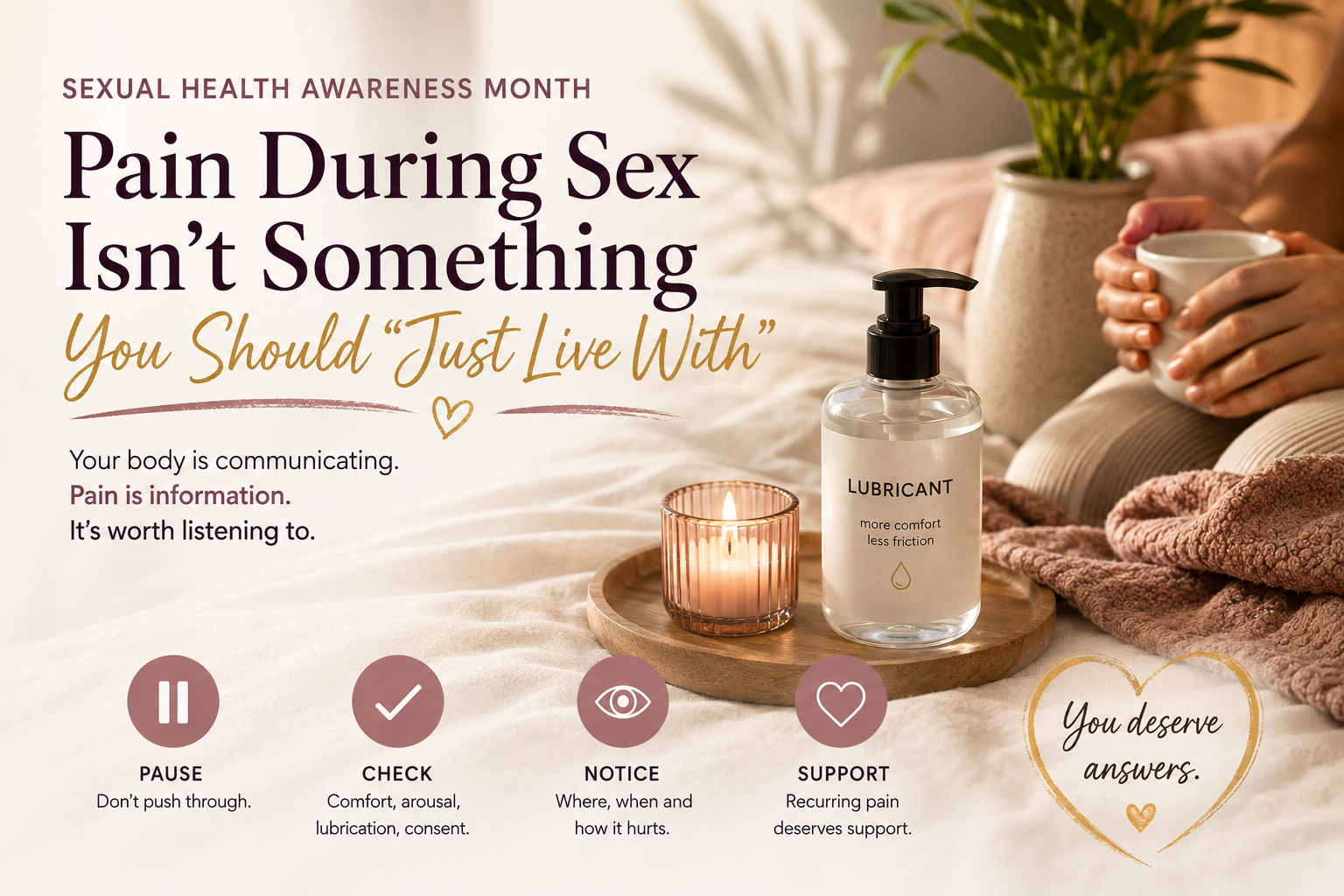
Pain is information. And it’s worth listening to.
Why can sex hurt?
There isn’t one simple answer because sexual health is rarely one-size-fits-all.
Pain or discomfort can be influenced by things like:
- Not enough lubrication or arousal
- Stress and pelvic-floor tension
- Hormonal changes during breastfeeding, perimenopause or menopause
- Postpartum recovery, injury or scarring
- Certain medications
- Infections or skin irritation
- Pelvic-floor dysfunction
- Endometriosis, adenomyosis or other pelvic conditions
And that’s not an exhaustive list.
Something else worth noticing is where and when the pain happens.
Does it burn or sting around the entrance?
Does penetration feel difficult or uncomfortable?
Is it a deeper pain with certain positions?
Does discomfort continue afterwards?
You don’t need to diagnose yourself (Dr Google can sit this one out), but noticing these patterns can give a healthcare professional useful information when helping you understand what may be going on.
Let’s talk about lubrication
Here’s one myth we’d happily retire:
“If you’re turned on, you should be wet.”
Nope.
Arousal and natural lubrication are related, but they’re not the same thing.
Hormones, stress, fatigue, medication, breastfeeding and menopause can all affect how much natural lubrication your body produces, regardless of how attracted, connected or mentally ready you feel.
And when there isn’t enough lubrication, increased friction can cause irritation or discomfort.
This is where a good-quality lubricant can be a wonderfully simple tool.
Lubricant can help reduce friction and improve comfort during sexual activity. And importantly, it’s not reserved for people experiencing vaginal dryness.
Think of it less as a “fix” and more as another tool in your sexual wellness kit.
Needing lube doesn’t mean your body has failed.
Sometimes your body simply appreciates a little backup.
But here’s the important bit…
Lube can help with friction. It can’t treat every cause of pain.
If adding lubrication, slowing down or allowing more time for arousal doesn’t resolve the discomfort, don’t keep pushing through it.
Persistent or recurring pain deserves proper attention.
Depending on the cause, support might include treatment for an infection or underlying condition, pelvic-floor physiotherapy, changes to medication, counselling or sex therapy, vaginal moisturisers, or hormonal and other medical treatments.
The right solution starts with understanding the cause.
The Liquid Gold Check-In: Pause → Check → Notice → Support
If something hurts during intimacy, try this:
1. PAUSE
You don’t win bonus points for pushing through pain.
Stop, slow down or change what you’re doing.
Consent also continues throughout intimacy you’re always allowed to change your mind when something doesn’t feel right.
2. CHECK
Ask yourself:
Am I comfortable? Am I aroused? Is there enough lubrication? Do I actually want to continue?
Add lubricant, change position, slow things down or switch to another form of intimacy altogether.
Penetration is not the only route to pleasure.
3. NOTICE
If the pain happens again, pay attention to the pattern.
Where does it hurt?
What does it feel like?
When did it start?
Does it happen every time or only sometimes?
Does anything make it better or worse?
Those details matter.
4. SUPPORT
If pain persists, keeps returning or worries you, speak to a qualified healthcare professional.
You deserve answers not another instruction to “just relax”.
When should I ask for help?
You don’t have to wait until pain becomes unbearable before speaking to someone.
If discomfort is persistent, recurring, getting worse or affecting your desire for intimacy or quality of life, it’s worth having the conversation.
A GP, gynaecologist, sexual-health clinician or pelvic-floor physiotherapist may be a good starting point depending on your symptoms.
And if talking about it feels awkward, you can literally start with:
“I’ve been experiencing pain during intimacy, and I’d like to understand why.”
That’s enough.
A healthcare professional may ask where the pain occurs, when it started, what it feels like, whether it happens every time, your medical and medication history, and whether you’ve experienced childbirth, surgery or other pelvic-health concerns.
Those questions aren’t there to embarrass you. They’re clues.
Intimacy doesn’t have to mean penetration
This deserves its own reminder.
If penetration hurts, intimacy doesn’t need to stop altogether.
Connection can look like:
- Kissing
- Massage
- External touch
- Mutual self-pleasure
- Cuddling
- Conversation
- Whatever consensual closeness feels good and comfortable to you
There is no prize for following one particular sexual script.
Pleasure can be expansive.
Let’s stop normalising pain
For too long, pain and discomfort have been dismissed as something we’re simply supposed to tolerate during sex, after childbirth, through hormonal changes or at different stages of life.
We can do better than that.
Pain during sex can have many causes. Sometimes, something as simple as additional lubrication can make a meaningful difference. Other times, your body may be telling you it needs more support.
Both are worth paying attention to.
Listen to your body. Get curious. Ask questions. And if something doesn’t feel right, don’t be afraid to seek support.
Because sexual wellness isn’t about pushing through discomfort. It’s about understanding your body, feeling comfortable and empowered, and making choices that feel right for you.
Pain isn’t the price of intimacy.
💛 Liquid Gold
Too Busy to Read? Here’s Your Golden Takeaway
Pain during sex is common but it isn’t something you should simply tolerate.
If something hurts:
PAUSE — don’t push through it.
CHECK — comfort, arousal, lubrication and consent.
NOTICE — where, when and how it hurts.
SUPPORT — recurring pain deserves professional attention.
And remember:
Wetness ≠ arousal. Lube can reduce friction, but persistent pain needs investigation.
Your body is communicating.
It’s worth listening to.
Sources & Further Reading
This article was informed by evidence-based guidance on painful intercourse, sexual function and genitourinary health from clinical resources including Mayo Clinic and the International Society for the Study of Women’s Sexual Health (ISSWSH).
This article is for educational purposes and isn’t a substitute for individual medical advice.